Blog post:
Deciding to start a family is an exciting and life-changing decision for many couples. However, for some, the journey to parenthood may not be as straightforward as they had hoped. Infertility affects about 1 in 8 couples, and many turn to assisted reproductive technologies to help them conceive. Intrauterine insemination (IUI) and in vitro fertilization (IVF) are two commonly used methods for fertility treatment, but what are the differences between them and how do you know which one is right for you? In this blog post, we will explore the ins and outs of IUI and IVF, helping you make an informed decision on which path to take in your journey towards parenthood.
What is Intrauterine Insemination (IUI)?
Intrauterine insemination, also known as artificial insemination, is a relatively simple fertility treatment that involves inserting specially prepared sperm directly into the uterus. The goal of IUI is to increase the chances of fertilization by bringing the sperm closer to the egg. This procedure is usually recommended for couples who have been trying to conceive for at least a year without success, have unexplained infertility, or have mild male factor infertility.
The IUI process involves monitoring the woman’s ovulation cycle to determine the best time for the procedure. The male partner will provide a semen sample, which is then washed and prepared to remove any non-motile sperm or debris. The prepared sperm is then inserted into the uterus using a thin catheter, bypassing the cervix and placing it closer to the fallopian tubes where fertilization takes place. The entire process is quick, painless, and can be done in a doctor’s office without the need for anesthesia.
What is In Vitro Fertilization (IVF)?
In vitro fertilization, on the other hand, is a more complex and invasive fertility treatment. It involves retrieving eggs from the woman’s ovaries and fertilizing them with sperm in a laboratory dish. The resulting embryos are then transferred back into the woman’s uterus, where they have the chance to implant and develop into a pregnancy. IVF is usually recommended for couples with more severe fertility issues, such as blocked or damaged fallopian tubes, severe male factor infertility, or advanced maternal age.
The IVF process begins with ovarian stimulation, where the woman takes medication to produce multiple eggs instead of the usual one egg per ovulation cycle. These eggs are then retrieved using a minor surgical procedure under anesthesia. The sperm is then combined with the eggs in a laboratory to allow fertilization to occur. Once the fertilized eggs have developed into embryos, one or more are transferred back into the uterus. Any remaining viable embryos can be frozen for future use.
What are the Pros and Cons of IUI and IVF?
Both IUI and IVF have their own set of advantages and disadvantages, and the right choice for you will depend on your individual circumstances and preferences. Let’s take a look at some of the pros and cons of each procedure.
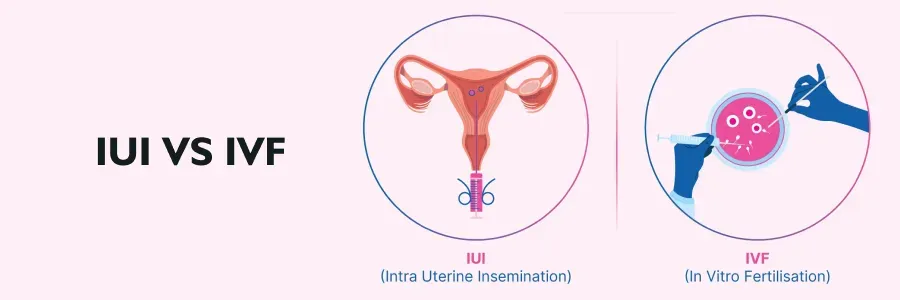
Making the Decision: Intrauterine Insemination vs In Vitro Fertilization
Pros of IUI:
– Non-invasive and relatively simple procedure
– Less expensive than IVF
– Can be done in a doctor’s office without the need for anesthesia
– Can use the male partner’s sperm, eliminating the need for a sperm donor
Cons of IUI:
– Lower success rates compared to IVF
– Limited use for couples with more severe fertility issues
– Requires at least one functional fallopian tube
– Does not address potential sperm quality or quantity issues
Pros of IVF:
– Higher success rates compared to IUI
– Can be used for a wide range of fertility issues
– Can use donor eggs or sperm if needed
– Allows for genetic testing of embryos before transfer
Cons of IVF:
– Invasive and more complex procedure
– Higher cost compared to IUI
– Requires ovarian stimulation and egg retrieval
– Increased risk of multiple pregnancies
How to Choose Between IUI and IVF?
Now that we have discussed the basics of IUI and IVF, how do you decide which one is the right choice for you? The answer will depend on various factors, including your age, overall health, fertility diagnosis, and financial situation. It is essential to have an open and honest conversation with your fertility specialist to understand the best course of action for your specific case.
If you have been trying to conceive for less than a year, are younger than 35, and have no known fertility issues, IUI may be a good starting point. It is less invasive, less expensive, and can be an effective treatment for some couples. However, if you have been trying to conceive for over a year, are 35 or older, or have more complex fertility issues, IVF may be a better option to increase your chances of success.
In some cases, IUI and IVF can also be used in combination to optimize the chances of pregnancy. For example, a couple may undergo an IUI cycle first, and if unsuccessful, move on to IVF. This approach may reduce the need for multiple IVF cycles and can be a more cost-effective option for some couples.
In Summary
Deciding between intrauterine insemination and in vitro fertilization can be a daunting task for couples struggling with infertility. While IUI is a simple and less expensive procedure, it may not be suitable for everyone. On the other hand, IVF has a higher success rate but can be more invasive and costly. Ultimately, the right choice will depend on your individual circumstances and should be made in consultation with a fertility specialist. Remember, there is no one-size-fits-all solution, and what works for one couple may not work for another. Stay positive, stay informed, and trust in the guidance of your medical team as you embark on your journey towards parenthood.